

Thinking of Time
And Slowing Down

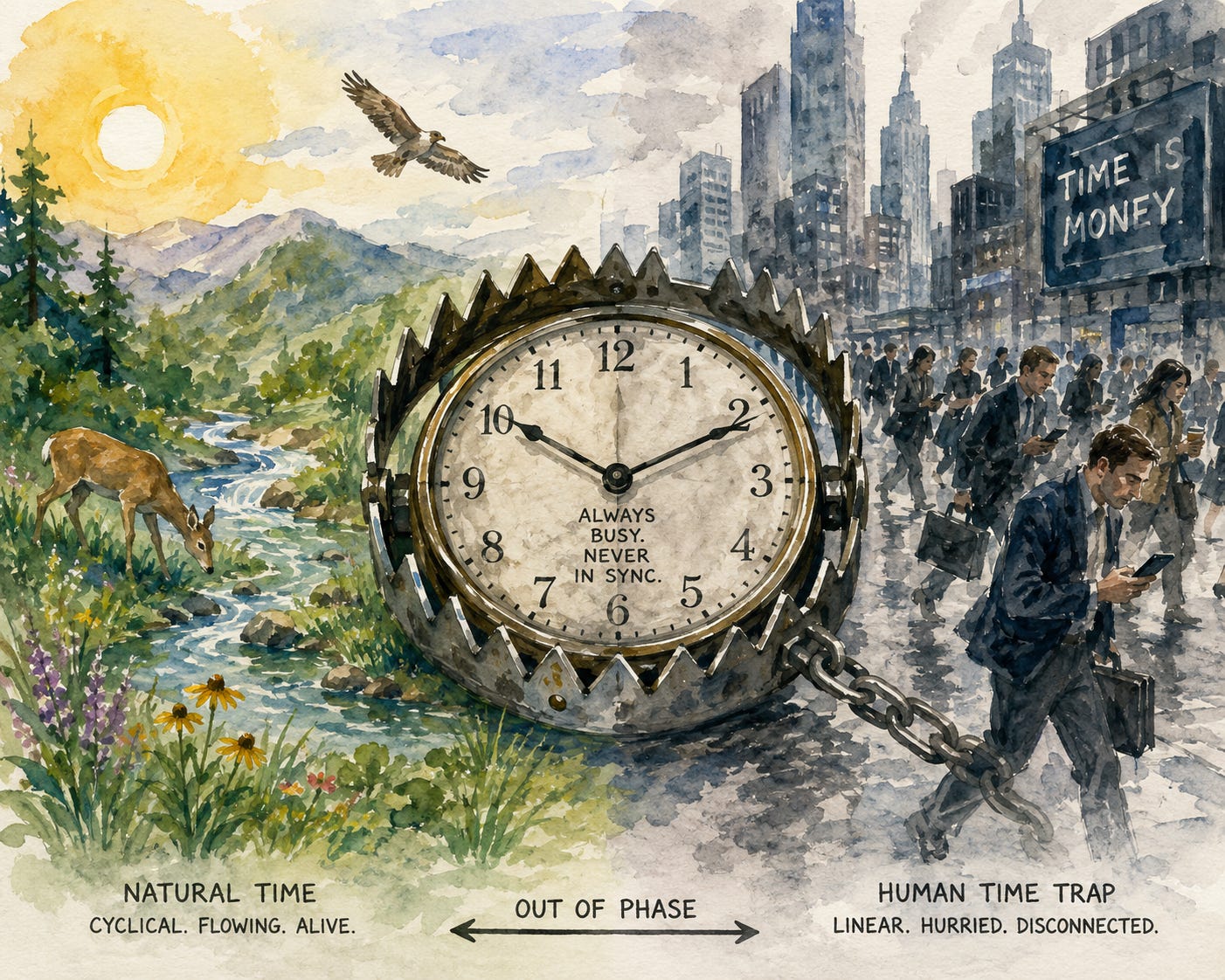
If you are feeling rushed, anxious, or just late for something not too important, maybe this five-minute read is what you need today. Mostly I wrote this so you could contemplate some wisdom regarding Time from a remarkable Lakota elder…
Physics tell us that, like light, time is a constant, moving in one direction towards the future. But we all know that as we get older, time accelerates. Years flash by. As a kid, the nine months of a coming school year had no perceptible end, stretched out to a distant, murky horizon. Now, in my eighth decade, it seems like we just put away the Christmas ornaments when it is time to get them down again. It seems that we just picked the last avocados in our grove and the new harvest is already weighing down the branches.
As a former geologist I see the world in four dimensions, not three; that fourth dimension is Time. Looking at a mountain, a river, a flat plain, the beach, my mind sees a movie of how they built or eroded or shifted over thousands or millions of years, chunks of time which are but the briefest flashes in the life arc of our earth. Anything humans have touched or built would hardly show up in these movies, appearing and disappearing in the tiniest fraction of even those flashes of time.
You can take great comfort in that, or not, as you wish. But it is true.
As I write in my new book, Wisdom Road: Searching America For Civility, Shared Values, and Common Ground (arriving January 2027), American culture, along with much of the modern human world, has fallen into a time trap that is out of phase with the natural world. As I wandered on my long cross-country road trip, mostly in rural America, I had the time to embrace just how deeply most of us construct our lifetimes around ever-smaller slices of generations, years, seasons, and days, measuring, monitoring, adhering to artificial time-rules and the little time-counting machines we have built to bind us. For many of us, life unbounded by the clock exists only in a dream-state. We measure ourselves by the LED on our wrist, how quickly we receive responses to our social media posts, the next quarterly report, our appointment calendar, the moments we punch in and out of work, the election cycle.
But listen to the wisdom and life lessons of Lakota elder Duane Hollow Horn Bear about a memory and sense of purpose that we only experience when we get rid of those modern handcuffs that bind us to artificial Time:
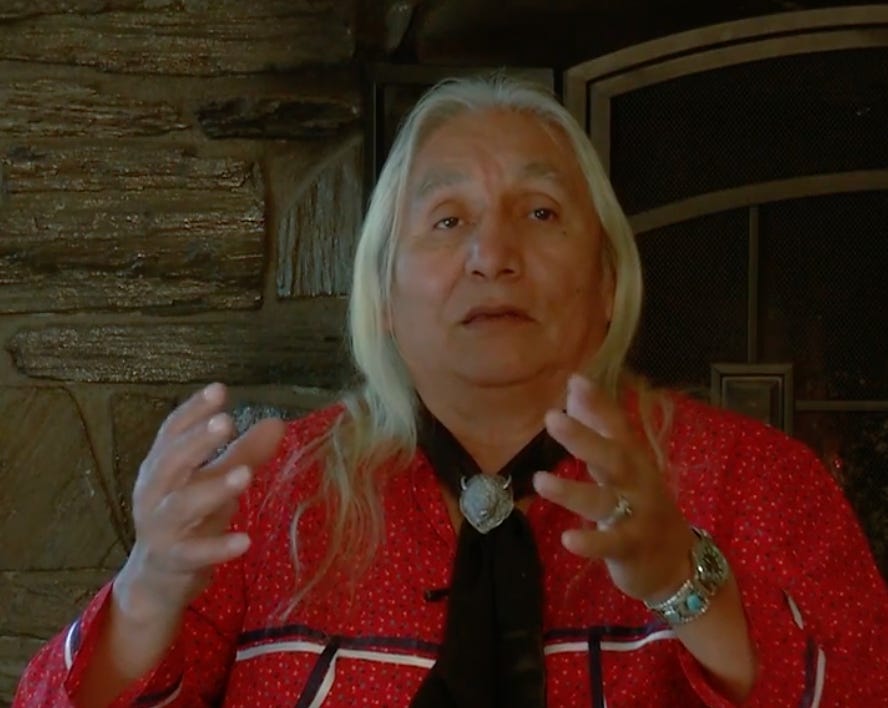
“The way that life was out here, there was plenty of buffalo, a lot of elk, plenty of deer, the rivers were full of fish. A man could get up in the morning, decide ‘I think I will go track an elk. Or maybe today I’ll go fishing. Or maybe today I’ll stay home with the wife. Maybe I’ll just kick back and relax. Or maybe I’ll go be a problem to the Crows over there today’. Then Western civilization came out here, thought they could improve on a system like that with their time clock.”
How deep is the irony that much of the land once roamed by the Lakota and other indigenous groups is now sold at sky-high prices to build resort ranches where time-pressed and weary modern Americans with enough money go to decompress for a week or so, doing much of what Duane’s grandparents were doing in the first place (except hopefully not troubling the Crows).
The oldest living organism on our planet (probably) is a stubby, weather-worn bristlecone pine tree, its elephantine roots welded into what passes for soil on the dry, sandy granite slopes of the White Mountains in easternmost California. Its grandparents were seedlings when sea level was so low that people walked from now-Russia to now-Alaska and from now-England to now-France. In just those three generations, what changes have come to pass, yet the bristlecones still hug the same mountainside that they did 10,000 years ago. I am not at all sure that Time is a constant when viewed from the respective reference point of humans and bristlecone pines.
In a few million or tens of millions of years, the great mountain ranges across America will likely be ground as flat as the Nebraska plains. In a few thousand years, the dams across our great rivers will lie in rubble. Enormous changes in the natural world over those frames of time are certain. What happens in the next few decades or hundred years, the portion of time that we and our children are destined to share, is far less certain.
But today I will listen to the lesson learned from Duane Hollow Horn Bear and just look at the avocados growing imperceptibly larger in the trees. It doesn’t mean I don’t care; just that Hollow Horn Bear has a point.